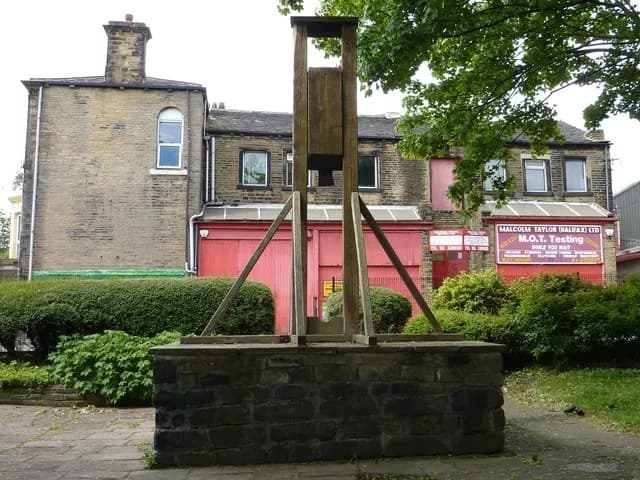
The Halifax Gibbet was a unique execution device that stood on the edge of this West Yorkshire town for centuries, claiming almost 100 lives before Oliver Cromwell ordered its dismantling in 1650. Unlike anywhere else in England, Halifax operated its own system of summary justice that allowed beheading for the theft of goods worth just thirteen and a half pence.
A Machine Like No Other in England
The gibbet consisted of two fifteen-foot wooden beams set parallel to one another, joined at the top by a transverse beam. A square wooden block, four and a half feet long, ran in grooves between these uprights. An axe head weighing nearly eight pounds was fitted to the base of this block. The entire mechanism sat upon a stone platform nine feet square and four feet high, accessed by a flight of steps.
A rope attached to the block ran over a pulley at the top of the structure, secured by a pin set into the stone base. When the pin was withdrawn or the rope severed, the block would drop with devastating force. Historical accounts suggest the mechanism was sometimes triggered by tying the rope to a stolen animal, which would then be driven forward to pull the pin.
The Gibbet Law and the Forest of Hardwick
The device operated under what was known as the Gibbet Law, an ancient right that may have been granted by Henry III to John de Warenne between 1231 and 1304. This law applied within the Forest of Hardwick, a jurisdiction that covered Halifax and the surrounding area.
The law permitted execution for theft of goods valued at thirteen and a half pence, a sum equivalent to approximately £9 in 2025. This threshold reflected the town's economic priorities. By the sixteenth century, Halifax had become a major producer of kersey cloth, a coarse woollen fabric that was left on tenterframes to dry in the open air. The swift justice of the gibbet protected this valuable trade from thieves who might otherwise make off with cloth left unattended.
Proceedings under the Gibbet Law were starkly different from conventional court processes. A jury of sixteen local men answered only two questions: whether stolen goods had been found upon the accused, and whether those goods exceeded the value threshold. There was no judge, no defence counsel, and no oaths administered. The accused was displayed in the stocks for three market days before execution.
One curious provision offered a slender hope of escape. If the accused could flee beyond the five-hundred-yard boundary of the Forest of Hardwick, they could not be legally recaptured. Historical records note the case of two men named Dinnis and Lacy, who successfully escaped in this manner. Lacy, however, returned after seven years and was executed in 1623.
The Recorded Victims
The first recorded execution occurred in 1286, when John of Dalton was beheaded. Parish records, which begin in 1538, document fifty-six men and women decapitated between that date and 1650. A commemorative plaque near the replica site lists fifty-two known names.
The last executions took place on 30 April 1650. Abraham Wilkinson was beheaded for stealing sixteen yards of russet kersey cloth valued at nine shillings. On the same day, Anthony Mitchell met the same fate for stealing and selling two horses. Some historical sources incorrectly record the first man's name as John Wilkinson rather than Abraham.
Why Halifax Was Different
The Gibbet Law represented a survival of the Anglo-Saxon infangthief custom, which granted baronial lords the right to execute thieves caught within their jurisdiction. Such rights were not unusual in medieval England, but they had largely been abandoned elsewhere by the time the Halifax Gibbet was finally dismantled.
Daniel Defoe, writing in 1727, reported that the device was "first erected purely, or at least principally, for such thieves as were apprehended stealing cloth from the tenters." The speed of this local justice contrasted sharply with the alternative. Royal assizes visited the area only twice yearly, and prosecution through those courts was prohibitively expensive. The Gibbet Law allowed rightful owners to recover stolen goods quickly.
The practice earned Halifax a dark reputation. The "Water Poet" John Taylor included the town in his Beggar's Litany of the 1620s: "From Hell, Hull, and Halifax, Good Lord, deliver us!"
The End of the Gibbet
Oliver Cromwell ordered the dismantling of the device after the executions of April 1650. The Puritan Lord Protector viewed beheading for petty theft as excessively severe and contrary to Puritan values. The stone base was rediscovered in the 1840s, and a full-size non-working replica was erected in August 1974.
In 2026, this replica is being replaced with an exact bespoke copy. The original stone base, which is Grade II listed, remains in place on Gibbet Street, approximately five hundred yards from the former boundary of the Forest of Hardwick.
Where to See the Remains
The replica gibbet stands on Gibbet Street, just off the main road, with St Mary's Catholic Church visible in the background. The original blade casting is displayed at Bankfield Museum on Boothtown Road, which offers free admission and is open Tuesday to Wednesday and Thursday to Saturday from 10:00 to 16:00.
The commemorative plaque listing the fifty-two known victims stands near the replica site, a sobering reminder of the nearly one hundred lives claimed by this unique instrument of medieval justice.